
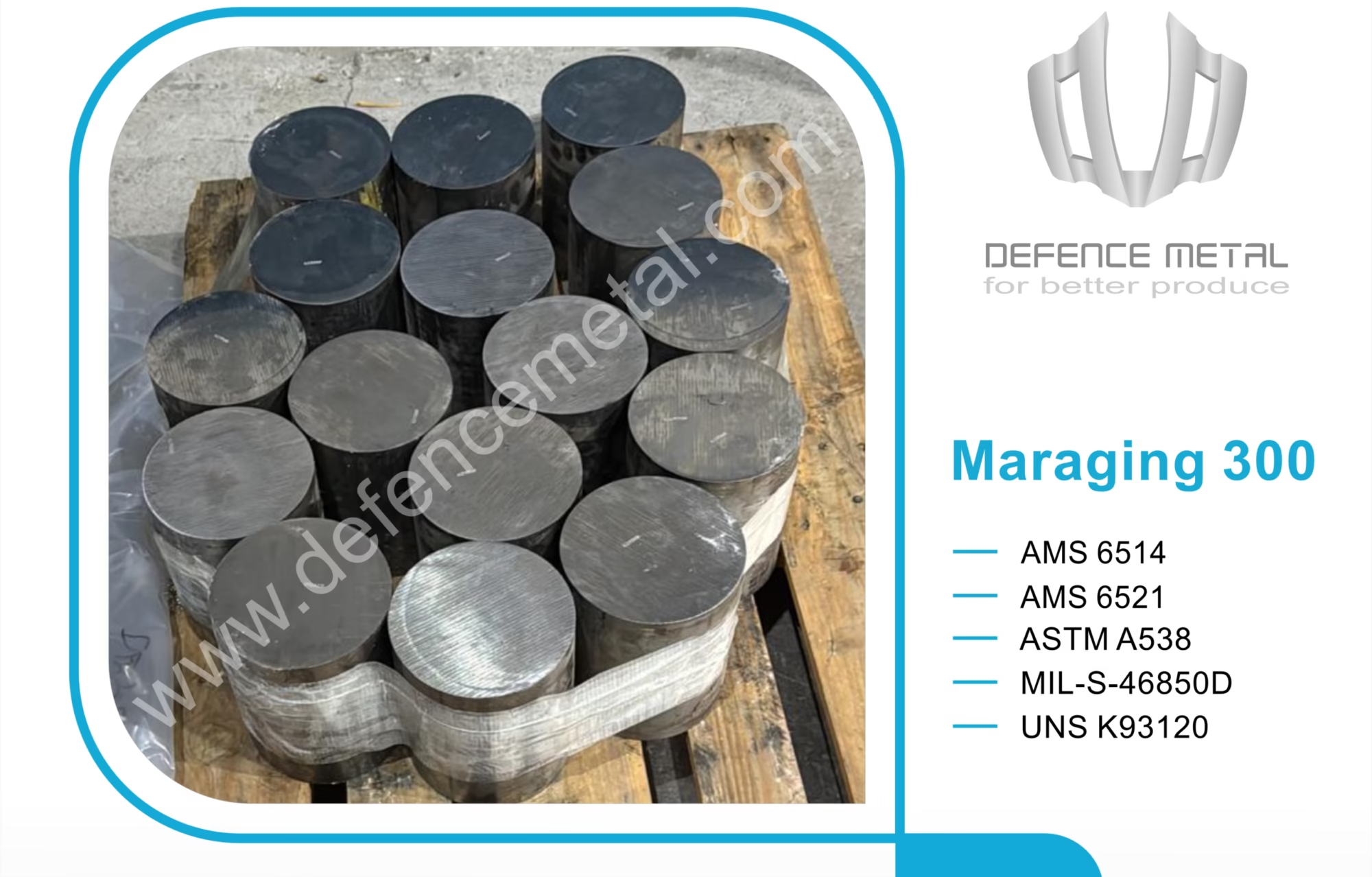
MARAGING 300
Maraging 300 Steel: The Industrial Meeting of High Strength and Ductility
Maraging 300 is a special alloy belonging to the class of martensitic age-hardenable steels, standing out for its high strength and excellent ductility. The alloy takes its name from “martensitic aging”, that is, from the improvement of its mechanical properties by the martensitic ageing treatment. Thanks to its superior durability, fatigue resistance and high-performance characteristics, Maraging 300 is widely preferred particularly in the aerospace, defence, automotive and high-technology sectors.
The chemical composition of Maraging 300, its mechanical properties, its heat treatment procedures, its specifications under the AMS and ASTM standards, its industrial fields of application and its commercial importance are examined comprehensively in this article in academic language.
Maraging 300 Chemical Composition and Microstructure
Maraging 300 is an alloy notable for its low carbon content and its high proportions of nickel, cobalt, molybdenum and titanium. This composition allows the alloy to acquire high strength, durability and ductility. The typical chemical composition is as follows:
- Nickel (Ni): 18.0–19.0%
- Cobalt (Co): 8.0–9.5%
- Molybdenum (Mo): 4.6–5.2%
- Titanium (Ti): 0.55–0.80%
- Aluminium (Al): 0.05–0.15%
- Carbon (C): maximum 0.03%
- Iron (Fe): balance
The microstructure of this alloy is martensitic, and after the ageing treatment very fine precipitates (intermetallic compounds) form, increasing hardness and durability. The low carbon level improves the machinability and weldability of the material, providing an advantage for high-performance applications.
Maraging 300 Mechanical Properties and Heat Treatment Procedures
The superior mechanical performance of Maraging 300 is achieved by suitable heat treatments. The heat treatment generally consists of two main stages:
- Solution annealing: carried out in the range of roughly 820–860 °C. With this operation the alloy acquires a homogeneous structure, the dissolved elements are freed and preparation is made for transformation to the martensitic structure.
- Ageing: carried out between 480 and 510 °C and lasting roughly 3 to 6 hours. At this stage the fine precipitates that provide hardening form within the alloy and the mechanical strength increases considerably.
The following mechanical properties are obtained as a result of the heat treatment:
- Tensile strength: 1700–1900 MPa
- Yield strength: 1600–1800 MPa
- Hardness: 48–52 HRC (Rockwell C)
- Elongation: between 4 and 6%
- Impact toughness: high
These mechanical properties make Maraging 300 an ideal alloy for critical applications requiring high strength and ductility.
AMS and ASTM Standards
As one of the materials of critical importance particularly in the aerospace and defence industries, Maraging 300 is subject to various international standards. These standards provide broad quality control, from the chemical composition of the material to the production process, and from mechanical testing to the certification stage.
- AMS 6509: an important aerospace standard defining the chemical composition and production processes of Maraging 300 steels as well as the mechanical test criteria.
- AMS 6510: this standard covers the post-heat-treatment mechanical performance and certification criteria of Maraging 300.
- ASTM A687: a general production and quality control standard for stainless and alloy steels, which can also be applied to maraging alloys.
Thanks to these standards, reliable and consistent performance of the Maraging 300 alloy on the international market is guaranteed.
Maraging 300 Technical Properties and Specifications
Maraging 300 stands out for technical properties such as high durability, superior fatigue resistance and high hardness. In addition, the low carbon content of the alloy considerably reduces the risk of crack formation in welding operations. Its other technical properties can be listed as follows:
- High strength-to-weight ratio: Maraging 300 offers high tensile and yield strength while keeping its light structure.
- Excellent ductility and impact strength: despite its high hardness, its brittleness is low.
- Good weldability: the low carbon and titanium contents reduce the risk of cracking after welding.
- A low coefficient of thermal expansion: provides dimensional stability even at high temperatures.
- Wear resistance: thanks to precipitation hardening it resists surface wear.
These technical properties make Maraging 300 ideal for parts requiring performance and durability.
Maraging 300 Industrial Fields of Application
The superior performance of Maraging 300 makes it indispensable in many advanced technology industries. Its most widespread fields of application are:
- Aerospace industry: Maraging 300 is used in landing gear, structural parts, rocket engine components and spacecraft members. High strength, low weight and high fatigue resistance are demanded in these critical applications.
- Defence industry: it meets durability and toughness requirements in missile parts, armour plating and high-performance military equipment.
- Automotive industry: preferred in the suspension systems, chassis and engine components of performance vehicles. High strength and light weight improve vehicle performance.
- Sports and recreation equipment: used for high durability in golf clubs, ski equipment and bicycle parts.
- High technology industry: widely used in the production of precision tooling and dies, in applications requiring high durability and hardness.
Production Process and Machinability
The Maraging 300 alloy is suitable for various production techniques such as casting, forging and machining. Because of its high alloy content and its tendency to harden, however, it is difficult to machine. The durability of the cutting tools and the cooling methods affect machining efficiency.
While hardness and durability increase after heat treatment, machinability decreases. Suitable pre-annealing operations may therefore be applied before machining. Welding operations must be carried out carefully; preheating and subsequent ageing are generally recommended. These stages minimise the risk of crack formation and preserve the mechanical performance of the material.
Advantages
- Very high tensile and yield strength
- Excellent ductility and impact toughness
- High weldability thanks to the low carbon content
- High hardness and wear resistance
- High fatigue strength, providing long-lasting performance
- A wide field of application and high performance
Disadvantages
- Its machinability is difficult and requires special cutting tools
- The heat treatment process is complex and time-consuming
- Its cost is high because of the high alloy content
- Welding operations demand care and special procedures
- In some cases excessive hardness can increase the risk of brittleness
Conclusion
Maraging 300 is a top-tier maraging alloy preferred in critical industrial applications requiring high strength, durability and excellent ductility. Full certification within the framework of the AMS and ASTM standards allows the material to be used with confidence in sectors such as aerospace, defence and automotive. Although it has special production, machining and heat treatment requirements, the performance it provides makes this steel attractive as an investment.
AMS6514
#AMS6521
ASTMA538
MILS46850D
UNSK93120
| Chemical Composition (Maraging 300 – X2NiCoMo19-9-5) | | Room Temperature Mechanical Properties | |
|---|---|---|---|
| Grade | Maraging 300 (1.6358) | Properties | Values |
| Ni | 18.0-19.0% | Density (Specific Gravity) | 8000 kg/m³ |
| Fe | 60.0-69.0% (typically ~67%) | Melting Point | Approx. 1413°C |
| Mo | 4.60-5.20% | | |
| C | max 0.03% | | |
| Mn | max 0.10% | | |
| Si | max 0.10% | | |
| P | max 0.01% | | |
| S | max 0.01% | | |
| Al | 0.05-0.15% | | |
| Co | 8.00-9.50% | | |
| Ti | 0.55-0.80% | |
We supply this material
We supply Maraging 300 (1.6358) — to AMS 6514 and AMS 6515, in the size and form required. For stock and pricing:
Related products
4340 VAR · Maraging 350 · AerMet 100 · AISI 8740 · All nickel alloys →