
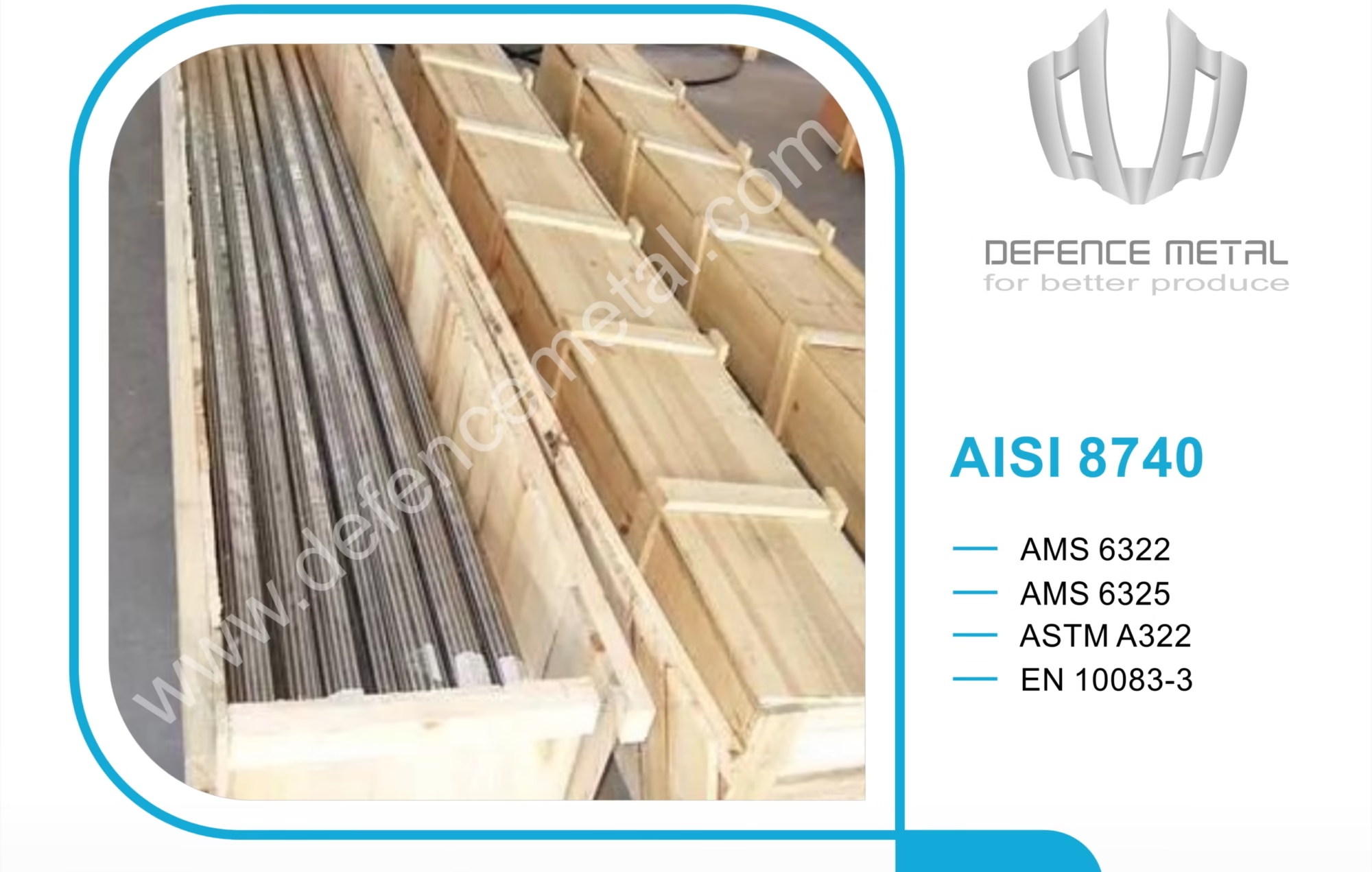
AISI 8740 Alloy Steel: Technical Properties, Industrial Applications and a Standardisation Perspective
AISI 8740 is a nickel-chromium-molybdenum alloy steel that stands out with its high strength, excellent ductility and good machinability properties. This alloy group is preferred especially in critical engineering applications such as aerospace, automotive, defence and highly stressed fasteners. Although AISI 8740 steel is of lower hardness compared with popular alloys such as 4140 and 4340, it has a broad area of application thanks to its improved formability and welding capability.
AISI 8740 Chemical Composition and Mechanical Properties
AISI 8740 steel has a chemical composition balanced so as to contain 0.38–0.43% carbon (C), 0.75–1.00% manganese (Mn), 0.15–0.35% silicon (Si), 0.40–0.60% chromium (Cr), 0.20–0.30% molybdenum (Mo), 0.40–0.70% nickel (Ni) and the remainder iron (Fe). This composition gives the alloy both tensile strength and ductility while at the same time increasing dimensional stability after tempering.
Its typical mechanical properties are defined, in a heat treated condition, by a tensile strength varying between 930–1080 MPa, a yield strength of approximately 760 MPa and an elongation value between 18–22%. The high tensile and yield strength make it suitable for systems operating under high load. In addition, the resistance it shows to crack propagation is also a parameter that increases the fatigue life.
AISI 8740 Heat Treatment and Microstructure
AISI 8740 steel is generally used after passing through heat treatments such as annealing, normalising, quenching and tempering (quench & temper). The annealing operation is carried out in the 830–860°C temperature range, and the microstructure is then made homogeneous with a controlled cooling. The quenching operation, on the other hand, is applied at 850–880°C, and oil cooling is generally preferred. The subsequent tempering operation is carried out in the 480–650°C range and the final hardness is set.
The microstructure formed after heat treatment contains martensite + tempered ferrite phases. This structure is critical in terms of providing sufficient toughness together with high strength. In AISI 8740 steels obtained by special production methods such as vacuum melting (VAR) or electroslag refining (ESR) in particular, the microstructural purity is at the highest level.
AISI 8740 Application Areas
AISI 8740 steel is used in a very wide variety of industries thanks both to its mechanical properties and to its formability advantages:
- Aerospace industry: Aircraft landing gear, fasteners (bolts, nuts), propeller shafts
- Automotive sector: Valve parts, gears, drive shafts
- Oil and gas sector: High pressure well equipment, fitting systems
- Defence and heavy industry: Ballistic system fasteners, tank parts
Preferred especially for bolts and pins under high stress, this alloy is suitable for parts with precise tolerances because it preserves its dimensional stability even after heat treatment.
AISI 8740 Standards and Certification
The AISI 8740 alloy is classified and certified according to various international standards. These function as an element of assurance in the quality control processes of producing companies and in the supply chain of users.
- ASTM A322: Sets out the general chemical and mechanical property limits for steel bars.
- AMS 6322 & AMS 6325: These are the most widespread AMS (Aerospace Material Specification) standards used for heat treated conditions of aerospace grade AISI 8740 materials.
- SAE J404: Used in the designation of steel alloys in the automotive and heavy equipment industries.
- EN 10083-3: A European standard, it covers the 40NiCrMo2-2 (W.Nr. 1.6546) alloy equivalent to AISI 8740.
Advantages
- High mechanical strength: Tensile and yield strength that can be improved by heat treatment.
- High toughness: A structure resistant to cracking and impact effects.
- Good weldability: Good welding performance with controlled preheating and low hydrogen electrodes.
- Machinability: It provides ease of machining in the annealed condition.
- Fatigue strength: It performs under repeated load thanks to microstructural homogeneity.
Disadvantages
- Corrosion resistance is low: Since it is steel-based it is unprotected against moisture and chemicals; galvanising or coating is required.
- Risk of distortion after heat treatment: Shape distortions may be observed after hardening, so careful control is required in precision parts.
- Low temperature ductility is limited: It may show a tendency to embrittlement in environments below -50°C.
Purchasing Perspective
When AISI 8740 steel is preferred in industrial purchasing, the function of the part, the desired hardness level, the tolerance precision and the environmental conditions of service should be taken into account. Suppliers generally offer this alloy in annealed, normalised or quenched-and-tempered condition as bar, plate and fasteners. In Türkiye this alloy is mostly supplied as an import.
Conclusion
The AISI 8740 alloy is used with confidence in many fields of modern engineering thanks to the balanced mechanical properties and production compatibility it possesses. It is an ideal solution especially for high strength fasteners and parts requiring fatigue strength. Offered in forms certified to the ASTM and AMS standards, with different heat treatment modifications, this alloy is a competitive alternative both technically and in terms of commercial availability. Taking quality certificates, the production methodology and supplier reliability into account in purchasing processes is of critical importance for long-term performance and cost effectiveness.
#ASTMA322
#AMS6322
#AMS6325
#SAEJ404
#EN10083-3
We supply this material
We supply AISI 8740 — to AMS 6322, AMS 6325 standards, in the dimensions and forms required. Contact us for stock availability and pricing.
Similar products
4340 VAR · Maraging 300 · Maraging 350 · AerMet 100 · All products →