
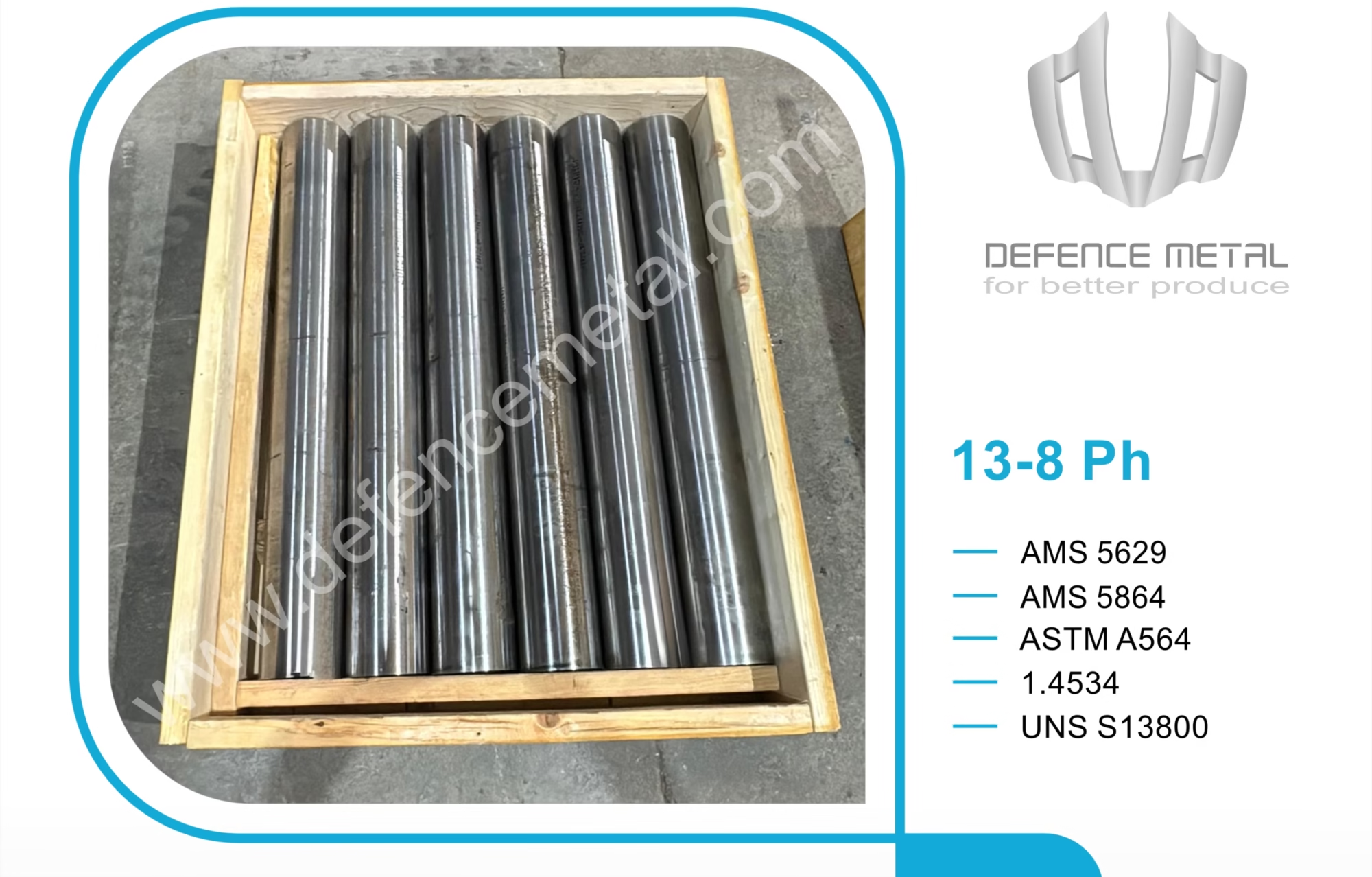
13-8 PH
13-8 PH Stainless Steel: The Strategic Balance of High Strength and Corrosion Resistance
13-8 PH stainless steel is a precipitation hardening martensitic stainless steel developed specifically for aerospace, defence and industrial applications requiring high performance. Thanks to the balanced combination of high strength, impact toughness and corrosion resistance it offers, it is widely accepted in engineering applications. The alloy takes its name from the roughly 13% chromium and 8% nickel in its composition, and is notable for the aluminium that contributes to precipitation hardening and for its low carbon content. Aluminium combines with nickel to form Ni₃Al (nickel–aluminium) phases during ageing, and this raises the hardness and strength of the material considerably.
Thanks to its controlled chemical composition, 13-8 PH can reach high mechanical values through solution annealing followed by ageing. Typically showing high hardness and strength thanks to the aluminium addition, this steel also provides ease of manufacture with its weldability and good impact strength. These properties make it attractive particularly for parts requiring high reliability.
During solution annealing the steel is heated at roughly 925 °C for a set period. A martensitic structure is then formed by rapid cooling. The ageing treatment applied after this stage imparts different mechanical properties depending on the temperature. Ageing at around 510 °C, for example, gives the highest tensile and yield strengths, while higher temperatures give greater ductility and impact toughness. The 13-8 PH alloy therefore offers a performance range that can be tailored to the intended use. This flexibility gives the user wide design options in terms of both part strength and fatigue life.
This material is defined in the precipitation hardening stainless steel class according to the ASTM A564/A564M standard. In addition, AMS 5629, the most widely used norm for the aerospace sector, sets out the technical requirements for 13-8 PH steel products in bar, forging and plate form. Products in plate form are subject to the AMS 5864 standard. Thanks to these standards the mechanical and chemical performance of the steel can be verified and quality control processes can be carried out soundly. This is of great importance particularly for vital parts such as aircraft structural components.
13-8 PH stainless steel appears in international supply chains under various trade names. Among the best known are Custom 455®, Alloy 13-8, PH 13-8 Mo and the code UNS S13800. Although these names vary between manufacturers, they represent products with the same technical content. European equivalents such as DIN 1.4534 are also available on the market. The fact that steels of this kind are produced to norms valid worldwide makes them easier to source and to integrate into engineering projects.
In terms of chemical composition, 13-8 PH steel gains its stainless character from a chromium content close to 13%, while the roughly 8% nickel provides both corrosion resistance and microstructural balance. In addition, the aluminium content close to 1% makes precipitation hardening possible. Thanks to this alloy structure, the hardness values obtained after ageing can exceed 45 HRC while the tensile strength can reach levels of 1900 MPa. These values are well above those of many conventional stainless steel classes.
13-8 PH stainless steel is used particularly in parts playing a critical role in the aerospace sector. Aircraft landing gear components, fasteners, engine parts and connection systems requiring high strength are among its main fields of use. In addition, the defence industry uses this alloy in high-security applications such as missile parts, weapon systems and armour fasteners. In the automotive sector it is preferred especially in high-performance vehicles for suspension systems, differential parts and fasteners. In the petrochemical and energy industries it is also used with confidence in valves, fasteners and structural parts exposed to corrosive environments.
Since this alloy has a magnetic martensitic structure, it may find limited use in some applications sensitive to electronic or electromagnetic fields. That property can become an advantage, however, in military sensor systems and electromechanical parts. In addition, the fact that machinability becomes more difficult after ageing means the production process has to be planned carefully. Generally, pre-machining of the part is carried out after solution annealing, and the final strength level is then imparted by the ageing treatment.
The corrosion resistance of the alloy is quite high compared with other martensitic steels that have a stainless character. It shows good resistance particularly in damp environments and those containing moderate levels of chlorine. In very aggressive acidic environments or in seawater, however, it may have limitations compared with more highly alloyed super duplex or super austenitic stainless steels. The service environment should therefore be analysed in detail and the correct alloy selected.
13-8 PH steel has a quite flexible nature in terms of production methods. It can be processed by traditional methods such as forging, rolling and machining. When the heat treatment processes are carried out carefully, dimensional stability and a homogeneous microstructure are achieved. This makes it possible for parts to perform their duty without loss of performance over long periods of operation. Low distortion after heat treatment is a great advantage, particularly for parts with tight tolerances. In that respect it is a preferred material in high-precision sectors such as aerospace.
When its advantages are assessed, 13-8 PH stainless steel stands out first of all for its high tensile and yield strength. After ageing, this steel offers far higher mechanical properties than the conventional austenitic stainless steels. At the same time, the fact that impact toughness can be adjusted according to the ageing temperature makes it possible to combine high strength with ductility. Thanks to the low carbon content, the risk of crack formation during welding is low. With its good corrosion resistance it provides long-lasting performance both in outdoor conditions and in industrial atmospheres.
Some disadvantages should also be taken into account, however. The reduction in machinability after ageing requires extra attention in production planning. In addition, the cost of the alloy is higher than that of the conventional stainless steels. It should therefore be chosen only in applications requiring high performance and safety. Its magnetic structure can also pose a problem in systems sensitive to electromagnetic interference.
In conclusion, 13-8 PH stainless steel is a strategic alloy from both an engineering and a commercial point of view. Bringing together properties such as high strength, impact resistance, corrosion resistance and weldability in a single material makes this steel indispensable for many critical applications. Its technical foundation, backed by ASTM and AMS standards, gives designers confidence while offering commercial users a sustainable solution in terms of quality and performance. Frequently sought in procurement with keywords such as “13-8 PH steel bar price”, “precipitation hardening stainless supplier” and “buy high-strength stainless”, this alloy is a strong alternative for advanced engineering solutions.
#1.4534
#13-8 Ph
#DIN X3CrNiMoAl13-8-2
#UNS S13800 Bar
#AMS5629
#AMS5864
#ASTMA564
#ASTMA693
#ASTMA705
| Chemical Properties | Min. | Max. | | Mechanical Properties | Value |
|---|---|---|---|---|---|
| C | - | 0.050 | | Tensile Strength (MPa) | 1480 |
| Mn | - | 0.20 | | Proof Stress (MPa) | 1415 |
| Si | - | 0.10 | | Elongation A50 mm | 13 |
| P | - | 0.010 | | Hardness Brinell | - Max HB |
| S | - | 0.008 | | Density | 7.8 g/cm3 |
| | | Melting Point | 1405-1440 °C | ||
| Cr | 12.25 | 13.25 | | Modulus of Elasticity | 221 GB |
| Ni | 7.50 | 8.50 | | Electrical Resistivity | 0.0001 ohm-cm |
| Mo | 2.00 | 2.50 | | Thermal Conductivity | 14.0 W/m.K |
| Al | 0.90 | 1.35 | | Thermal Expansion | - |
We supply this material
We supply 13-8 PH (1.4534) — to AMS 5629 and AMS 5864, in the size and form required. For stock and pricing:
Related products
15-5 PH · 17-4 PH · 17-7 PH · Custom 455 · Precipitation hardening steels →