
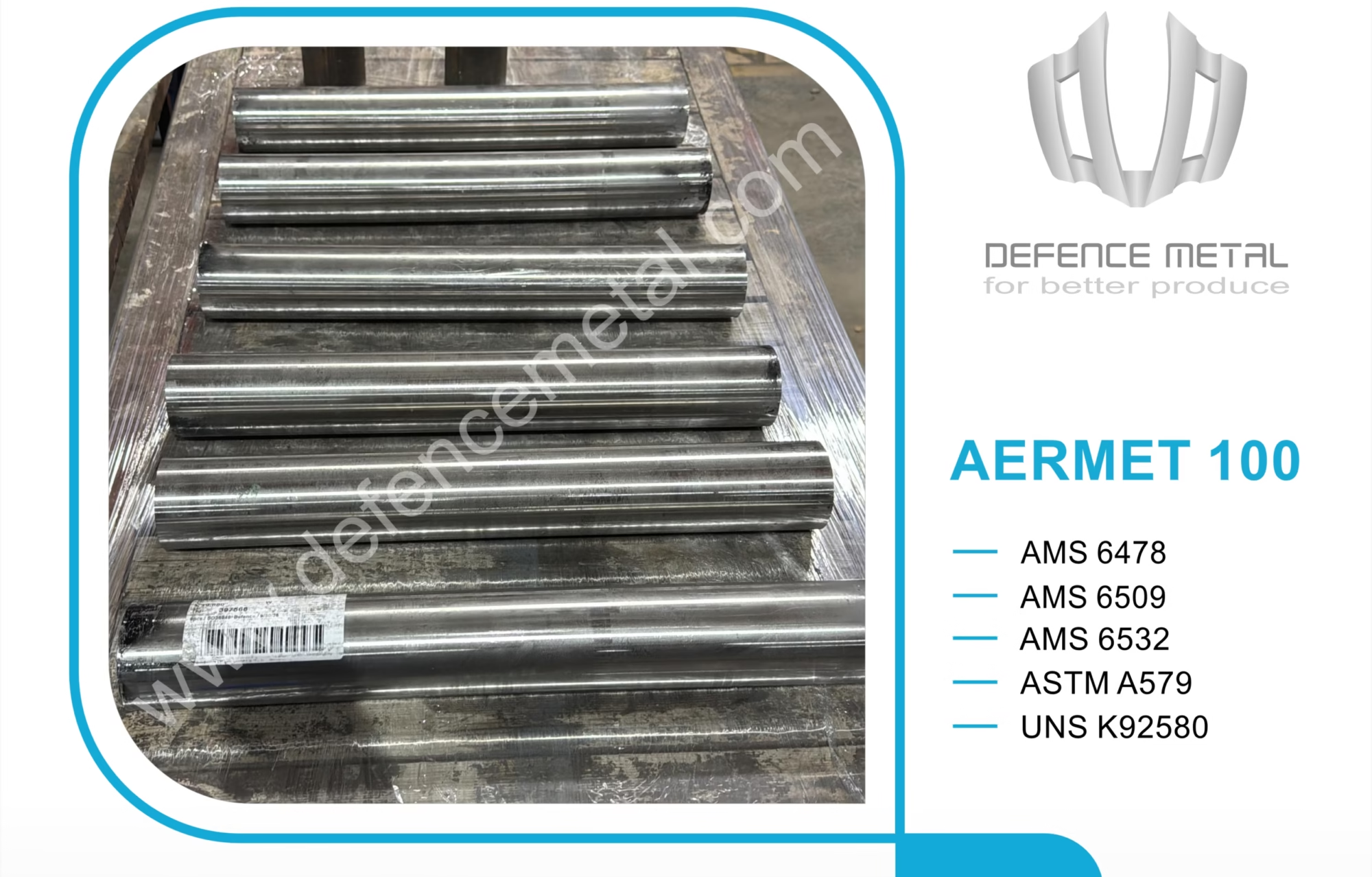
AerMet 100
High-strength alloy steels used in advanced engineering applications are among the indispensable building blocks of today’s aerospace and defence industries. AerMet 100 is one of the most remarkable steels developed in this field. With its exceptional tensile strength, fracture toughness and fatigue resistance, it is the material of choice in applications where structural safety is critical. The unique structural properties of AerMet 100 make it widely usable in areas demanding high performance and long service life, such as aircraft landing gear, helicopter rotor components and ballistic protection systems.
Structural Properties
AerMet 100 is a precipitation-hardened, ultra-high-strength alloy steel with a martensitic structure. This particular microstructure is optimised to deliver both high strength and exceptional toughness. Producing the steel by vacuum induction melting (VIM) and vacuum arc remelting (VAR) increases its structural homogeneity and, by lowering the impurity level, improves critical mechanical properties such as fatigue strength.
Chemical Composition
The chemical composition of AerMet 100 can be summarised with the following typical values:
- Nickel (Ni): 11.0 – 12.0%
- Cobalt (Co): 13.0 – 14.0%
- Chromium (Cr): 2.9 – 3.3%
- Molybdenum (Mo): 1.1 – 1.3%
- Carbon (C): 0.21 – 0.25%
- Silicon (Si), Manganese (Mn), Phosphorus (P), Sulphur (S): trace amounts
- Iron (Fe): Balance
The high nickel and cobalt content has a direct effect on both hardness and toughening, while molybdenum and chromium raise corrosion resistance and hot hardness in particular. This composition allows the steel to reach optimum mechanical values after solution annealing and ageing.
Heat Treatment and Microstructural Development
A controlled heat treatment process is required for AerMet 100 to reach its target mechanical properties. Solution annealing is typically carried out at 885 °C for 1 hour, followed by rapid cooling by quenching. This makes the structure fully martensitic. Ageing at 482 °C for approximately 5 hours then forms carbide and intermetallic precipitates, raising hardness and strength.
After the correct heat treatment the material attains a lath martensite structure with a fine grain size and a high dislocation density. That structure gives it high fatigue resistance and fracture toughness. Precise control of the heat treatment stages is critically important for engineers using the product to maintain consistent quality in production.
AerMet 100 Mechanical Properties
After heat treatment, AerMet 100 can deliver the following mechanical properties:
- Tensile strength: ≥ 1930 MPa
- Yield strength: ≥ 1725 MPa
- Hardness: 50 – 53 HRC
- Fracture toughness: ≥ 110 MPa√m
- Fatigue resistance: excellent performance under high-cycle loading
These values make AerMet 100 superior to 4340, one of the traditional aerospace steels, and to high-performance alloys such as the maraging steels. At the same time, its resistance to impact loads and to micro-crack propagation makes it the preferred material in applications where structural integrity is vital.
AerMet 100 Standards and Specifications
AerMet 100 is produced in accordance with various aerospace and engineering standards. This allows it to be used without difficulty in projects that have to meet international quality expectations.
- AMS 6532: This standard defines the chemical composition, mechanical properties and production details of AerMet 100.
- AMS 6509: Contains the technical procedures specified for the ageing process.
- ASTM E8 / E8M: Provides the general framework for tensile testing.
- ASTM E399: The reference standard used for fracture toughness measurements.
- ASTM A579: Covers test methods for high-strength alloys.
Conformity with these standards is a decisive criterion in purchasing, both for product quality and for supply chain reliability. These specifications are particularly instructive for the quality engineers and purchasing managers working in the aerospace and defence industries.
AerMet 100 Fields of Application
AerMet 100 is widely used in the following sectors, where high performance is expected:
- Aerospace: aircraft landing gear, helicopter rotor systems, fasteners
- Defence: ballistic armour assemblies, ammunition components, structural armour connections
- Space technology: system components working at high temperature
- Automotive and motorsport: suspension linkages carrying high impact loads
- Energy: turbine shafts resistant to high pressure
These applications bring to the fore not only the strength of AerMet 100 but also its resistance to micro-crack propagation. AerMet 100 is a preferred choice especially in sectors that demand a high safety factor in impact and fatigue behaviour.
AerMet 100 Commercial Applications
1. Aerospace Industry
- Aircraft landing gear: thanks to the high tensile strength (>1900 MPa) and fracture toughness of AerMet 100, it performs excellently against sudden impacts in landing gear.
- Rotor and propeller shaft components: rotor shafts in helicopters have to withstand both dynamic loading and fatigue. AerMet 100 is regarded as the ideal material for these parts.
- Fasteners and bolts: for the high-strength fasteners used in aircraft assembly, AerMet 100 offers both safety and a weight advantage.
2. Defence and Ballistic Systems
- Armour support structures: in ballistic armour systems AerMet 100 is used particularly in the internal structural members, because it offers both bullet resistance and resistance to deformation after impact.
- Ammunition components: used in missile and bomb bodies and in propulsion systems, for strength and shape integrity after detonation.
- Weapon mechanisms: barrel locking systems exposed to high pressure and repeated loading are among the ideal applications of AerMet 100.
3. Space Industry
- Satellite structural members: with its dimensional stability against temperature changes, AerMet 100 can be used in the internal support systems of satellites.
- Rocket connection parts: high-strength structural steel is required for the severe mechanical stresses rockets are exposed to on their way out of the atmosphere; this is where AerMet 100 stands out.
4. Automotive and Motorsport
- Performance vehicle suspension systems: in Formula cars and performance-oriented suspension systems, AerMet 100 offers both rigidity and impact strength.
- Shaft and spindle components: especially in high-speed, high-torque systems, its fatigue life and fracture resistance are an advantage.
5. Industrial Engineering and Energy
- High-pressure turbine components: used in the shafts and connection parts exposed to temperature and mechanical stress in steam and gas turbines.
- Critical bolts and fasteners: found in the special fastening systems used in refinery and power plant applications.
These commercial applications make AerMet 100 a strategic material for engineering companies “looking to buy high-performance steel”, for defence suppliers seeking ballistic protection solutions and for manufacturers in the aerospace sector that put safety and strength first.
Conclusion
In conclusion, AerMet 100 is an engineering material that stands out in the ultra-high-strength steel class for both its mechanical performance and its microstructural stability. The superior properties obtained through vacuum melting and precise heat treatment steps have made it an attractive option not only for advanced sectors such as aerospace and defence, but also for fields demanding precision such as motorsport and nuclear energy.
As a natural consequence of that level of performance, however, the production costs of AerMet 100 are high. Its limited weldability, the difficulty of machining it and the precise control required during ageing all call for a careful approach in production. For that reason the product should be used only in projects with high engineering expectations and under expert supervision.
Academic and industrial work on AerMet 100 suggests that the material may find wider use in the future. Combined with optimisation of the alloy composition, better weldability, improved corrosion resistance and cost-reducing production techniques, AerMet 100 may come to be regarded as an even more widely applicable solution.
#AMS6532
#AMS6478
#UNSK92580
We supply this material
We supply AerMet 100 — to AMS 6532 and AMS 6478, in the size and form required. Contact us for stock and pricing.
Related products
4340 VAR · AISI 8740 · Maraging 300 · Maraging 350 · All products →