
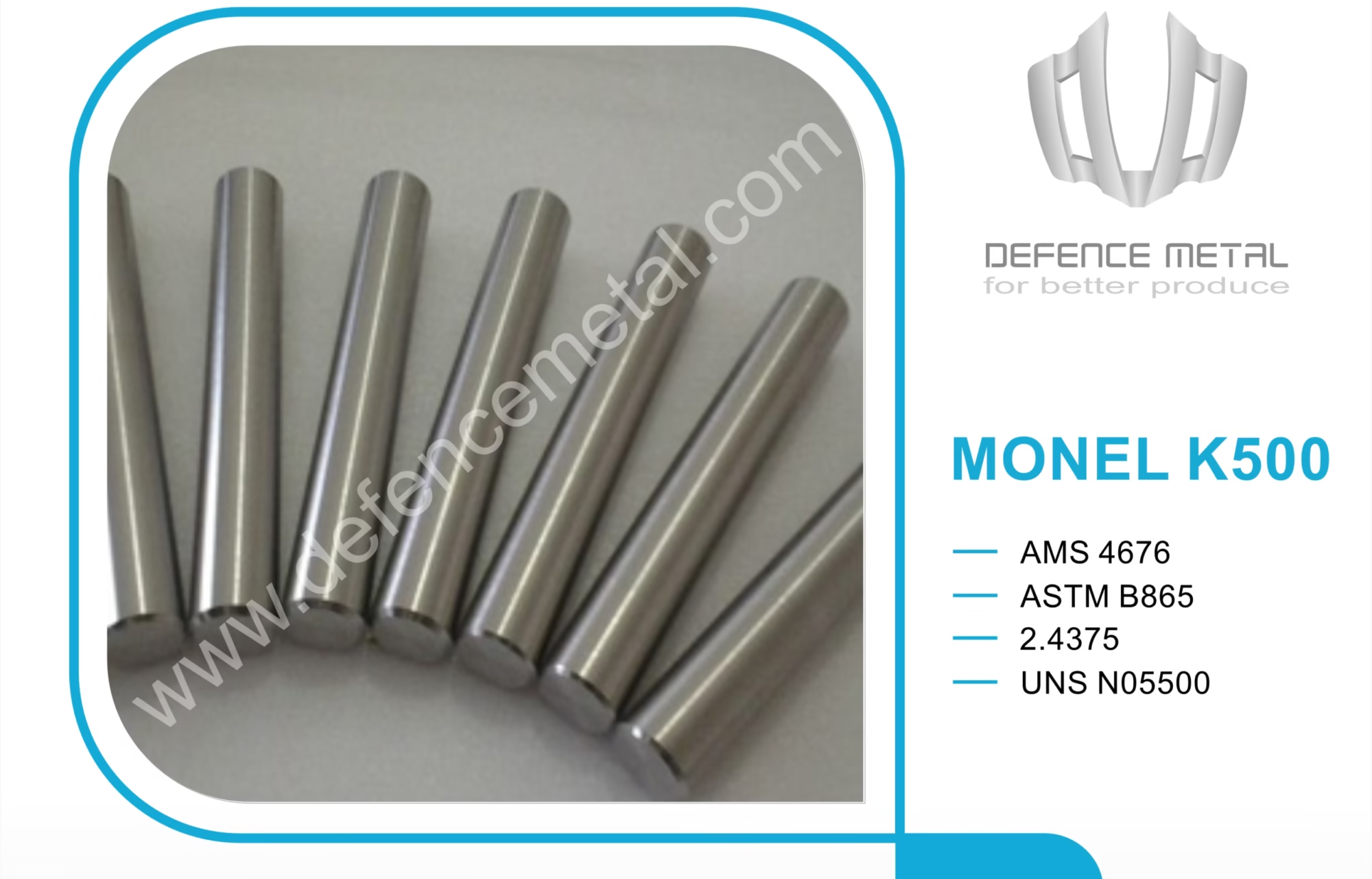
MONEL K-500 (UNS N05500): An Age Hardened Nickel-Copper Alloy
Alloy Definition and Chemical Composition
Monel K-500 is an enhanced version of the nickel-copper based Monel 400 alloy. This alloy is a material that preserves the high corrosion resistance of Monel 400 while its mechanical strength has been increased by the precipitation hardening method through the addition of the elements aluminium and titanium. Monel K-500 draws attention with its high strength, excellent ductility, extraordinary resistance to sea water and non-magnetic properties.
Typical chemical composition (% by weight):
- Nickel (Ni): 63.0% min (contains some cobalt)
- Copper (Cu): 27.0–33.0%
- Aluminium (Al): 2.3–3.15%
- Titanium (Ti): 0.35–0.85%
- Iron (Fe): 2.0% max
- Manganese (Mn): 1.5% max
- Silicon (Si): 0.5% max
- Carbon (C): 0.25% max
- Sulphur (S): 0.01% max
The precipitation hardening carried out after the ageing operation is achieved through the formation of nickel-aluminium and nickel-titanium phases.
MONEL K-500 Standards and Specifications
Monel K-500 is an alloy defined in detail in international technical standards. The principal norms taken as a reference in purchasing and engineering design:
- ASTM B865 – For Monel K-500 bar, forged and formed products
- ASTM B564 – Flanges and fittings
- ASTM B163 / B165 – Pipes and tubes
- UNS N05500 – Unified Numbering System code
- AMS 4676 – Hardened bar and forged products for the aerospace industry
- ISO 6208
- Werkstoff Nr. 2.4375 – Its equivalent according to the German DIN standard
MONEL K-500 Trade Names and Equivalent Materials
- Monel® K-500 – Trade name registered by Special Metals Corporation (SMC)
- Alloy K500
- Nicrofer 5120 – Under the VDM Metals brand
- 2.4375 – DIN/Werkstoff designation
- Nicorros® K500 – Haynes International equivalent
These trade names may appear differently in suppliers’ catalogues. All variants carry the same technical characteristics.
MONEL K-500 Mechanical and Physical Properties
Monel K-500 is an alloy to which an age hardening operation has been applied. It therefore has much higher strength values than Monel 400. It can be machined in the unhardened condition and is then hardened by ageing.
Typical mechanical values in the aged (hardened) condition:
- Tensile Strength: 965–1100 MPa
- Yield Strength: 690–830 MPa
- Elongation (%): 15–25%
- Hardness (Rockwell C): RC 22–35
- Density: 8.44 g/cm³
- Melting point: 1300–1350 °C
- Thermal conductivity: ~21 W/m·K
- Modulus of elasticity: 179 GPa
It is easier to machine in the un-aged (annealed) condition; strength increases markedly after ageing. Its non-magnetic character may become partially magnetic with ageing, but remains at a low level.
Application Areas
Both the corrosion resistance and the high strength of Monel K-500 make it an important engineering material in the following fields:
1.Oil and Gas Industry
#Pump shafts, well tools, drilling parts
#Fittings used in sulphurous gas and crude oil environments
2.Marine
#Propeller shafts, underwater fasteners
#Subsea pump and valve systems
#Shafts and fasteners exposed to salt water
3.Chemical and Process Industry
#Agitators operating in abrasive environments
#Valves in contact with alkaline and acid solutions
4.Aerospace
#Hydraulic system parts
#Fasteners, bolts and rivets
#Gas turbine components
5.Military Applications
#Torpedo propellers
#Submarine parts and surface vessel connection systems
Monel K-500 is qualified to serve, besides its high mechanical strength, in environments where environmental corrosion is intense.
Advantages
- High Mechanical Strength: It offers approximately twice the tensile and yield strength compared with Monel 400.
- Corrosion Resistance: It shows high resistance to sea water, sulphur compounds, alkalis and many acid environments.
- Hardenability by Ageing: An increase in strength can be achieved by heat treatment.
- Non-Magnetic Character (Partly): In the un-aged condition it has a completely non-magnetic structure.
- Cryogenic Stability: It does not compromise on ductility at low temperatures and shows no embrittlement.
Disadvantages
- Restricted Machinability After Heat Treatment: Machinability becomes difficult after ageing; operations should generally be carried out before hardening.
- Partial Magnetisation: After ageing, weak magnetism may arise at a level that is unwanted for some applications.
- High Cost: Its nickel-based structure and the ageing operations make it economically high in cost.
- Limited Performance in Oxidising Acids: It is not preferred in environments such as nitric acid; alloys of the Inconel or Hastelloy class are more suitable for these conditions.
Conclusion and Engineering Evaluation
Monel K-500, while preserving all the corrosion durability advantages of Monel 400, has been turned through ageing heat treatments into a high strength super alloy with high fatigue strength. Thanks to these properties it is used with confidence in subsea systems, drilling tools and aerospace fasteners alike.
With its age hardening property it can adapt to different design requirements across a broad engineering spectrum. In environments where high performance is sought but stainless steels fall short, Monel K-500 offers, when assessed from both a technical and an economic point of view, a top level engineering solution.
#MonelK500
#AlloyK500
#AlloyK500
#UNS N05500
#2.4375
#ASTMB865
#AMS4676
| Chemical Composition (Monel K-500) | Room Temperature Mechanical Properties | | |
|---|---|---|---|
| Grade | Monel K-500 (2.4375) | Properties | Values |
| Ni+Co | min 63.0% | Density (Specific Gravity) | 8440 kg/m³ |
| Cu | 27.0-33.0% | Melting Point | 1315 – 1350 °C |
| Fe | max 2.00% | | |
| C | max 0.25% | | |
| Mn | max 1.50% | | |
| Si | max 0.50% | | |
| S | max 0.01% | | |
| Al | 2.30-3.15% | | |
| Ti | 0.35-0.85% | |
We supply this material
We supply Monel K-500 (2.4375) — to the AMS 4676 standard, in the dimensions and forms required. For stock availability and pricing:
Similar products
Waspaloy · Nimonic 80A · Haynes 25 · Inconel 600 · All nickel alloys →