
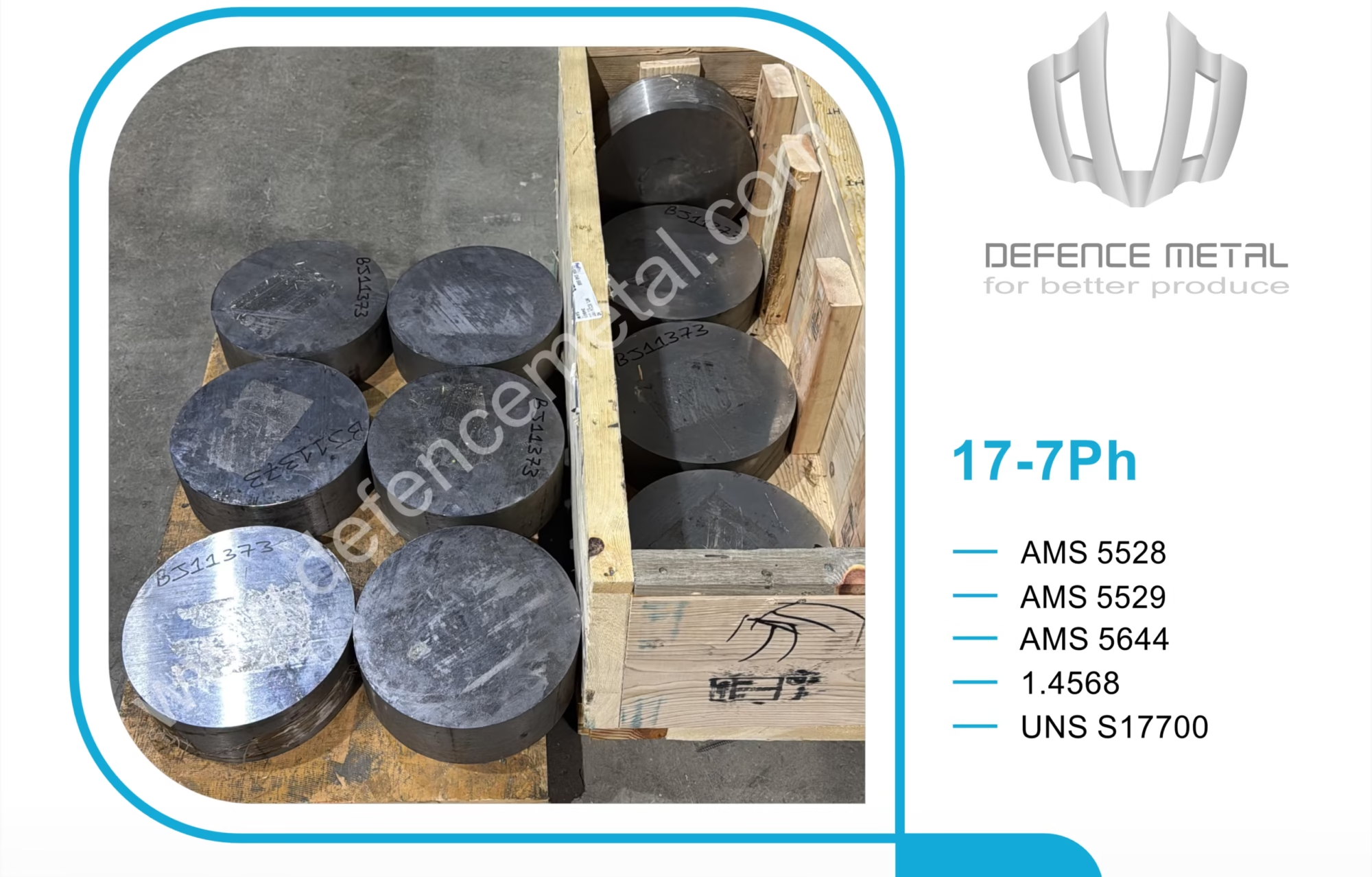
17-7 PH
17-7 PH Stainless Steel: Where Elasticity and Mechanical Performance Meet High Corrosion Resistance
17-7 PH stainless steel is one of the advanced engineering alloys belonging to the precipitation hardening (precipitation hardening – PH) stainless steel class, preferred particularly in applications that require high elasticity, good corrosion resistance and temperature strength. Used in the aerospace, automotive, nuclear and medical sectors, 17-7 PH shares some properties with 17-4 PH, yet differs from it through its higher elastic recovery capability, superior spring performance and wider service temperature range.
With its high elastic limit, dimensional stability and mechanical properties that can be tailored through ageing, this alloy stands out in parts exposed to dynamic loads, such as spring and sealing applications.
Chemical Composition and Microstructure of 17-7 PH
The chemical composition of 17-7 PH stainless steel essentially contains 17% chromium, 7% nickel and a small amount of aluminium (around 0.75%). Aluminium is the critical element that makes this alloy suitable for precipitation hardening. Thanks to the low carbon content (0.09% maximum), weldability and formability are preserved, while the high chromium ratio provides corrosion resistance.
In terms of microstructure, a two-stage heat treatment is applied in the production of the alloy. First it is brought to an austenitic structure by solution annealing, then transformation to a martensitic structure is achieved by low-temperature ageing and an increase in hardness is obtained through intermetallic precipitates. This process is generally applied under various ageing regimes such as TH1050, RH950 and CH900.
Standards and Technical Properties of 17-7 PH
17-7 PH stainless steel is defined by the following technical standards:
- ASTM A564 / A564M: General purpose bar, wire, plate and forged products.
- AMS 5644: Aerospace standard for bar, wire, forged parts and heavy plate.
- AMS 5528: For sheet and strip materials.
- UNS S17700: International chemical designation.
After ageing, the tensile strength can range between 1250–1550 MPa, the yield strength between 1150–1450 MPa, and the hardness between Rockwell C 38–47. Together with these high strength properties, its modulus of elasticity and suitability for use as a spring steel bring the alloy to the fore especially in dynamic applications.
Trade Names and Supply Chain of 17-7 PH
The 17-7 PH alloy is present in the global market under various trade marks. The most common trade names are:
- 17-7 PH® Stainless
- UNS S17700
- AISI Type 631
- DIN 1.4568
- X7CrNiAl17-7
This alloy can be supplied in various forms such as wire, bar, plate, strip and tube.
Application Areas of 17-7 PH
17-7 PH steel is preferred in environments that require high flexibility and recovery capability under load. Its common areas of use are as follows:
- Aerospace: Fuel valves, control springs, flight systems.
- Nuclear industry: Reactor component springs, vibration damping components.
- Medical devices: Orthodontic wires, minimally invasive surgical springs, precision medical spring systems.
- Petrochemicals: Sealing gaskets under pressure and spring-loaded connection systems.
- Automotive: Suspension springs, braking system springs, flexible gaskets.
- Defence industry: Guide rails, locking systems, elastic energy storing parts.
In most of these applications both high strength and stable mechanical behaviour under long-term repeated loading are essential. 17-7 PH is able to meet these requirements through ageing-controlled mechanical property settings.
Heat Treatment Properties and Hardening
17-7 PH stainless steel can be hardened by three basic ageing routes:
- TH1050 (Temper Hardened): This is the most widely used method. Ageing is applied in the range of 950–1050°F (510–565°C). As a result, high hardness and tensile strength are obtained.
- RH950 (Reverted Hardened): After pre-ageing, the material is transformed back to an austenitic structure by a further solution anneal, then re-hardened at the RH temperature. It is preferred where high elasticity and elongation are required.
- CH900 (Conditioned Hardened): This is a process that provides high hardness with short-duration ageing. However, machinability and ductility may decrease.
Each regime is chosen according to the balance of strength and ductility required in different applications. In spring applications in particular, higher elasticity and energy recovery are achieved with TH1050.
Corrosion Resistance and Environmental Durability
17-7 PH stainless steel offers good corrosion resistance despite its typical martensitic structure. This resistance stems from the 17% chromium content and the tight grain structure. The alloy is durable in humid environments, mildly acidic conditions, industrial atmospheres and some chloride-bearing environments. Nevertheless, when compared with austenitic stainless steels (for example 304 or 316), it is less resistant to pitting corrosion.
It is also advantageous in terms of high temperature strength. It shows stable performance particularly up to the 600°F (316°C) level. Because of its long-term thermal stability, it is ideal for spring systems operating at high temperature.
Machinability and Production Methods
Its machinability after solution annealing is at a medium level. It is difficult to machine in the hardened condition; for this reason all machining steps should be carried out before heat treatment. High speed steel (HSS) or carbide-tipped tools are recommended for machining operations. The final hardness is provided by ageing after machining.
Its weldability is better than that of other martensitic steels, but re-ageing after welding is essential. Otherwise embrittlement and microstructural heterogeneity may be observed in the weld zone.
Advantages:
- High elastic limit and good spring characteristics.
- Controlled mechanical property adjustment through precipitation hardening.
- Good corrosion resistance and high temperature performance.
- Compliance with critical aerospace standards such as ASTM A564 and AMS 5644.
- Availability in a wide variety of forms: strip, wire, bar, plate.
Disadvantages:
- Limited pitting corrosion resistance compared with austenitic steels.
- Difficult machinability in the hardened condition.
- Ageing after welding is mandatory.
- There may be a risk of carbide precipitation and embrittlement at high temperatures.
Purchasing Strategies and Engineering Evaluation
The intended use of the alloy should be determined and the most suitable ageing regime selected, with supply provided in forms and standards matching it.
AMS certified material should be preferred especially for aerospace and defence industry applications. These certificates are of great importance both for traceability and for the accuracy of mechanical testing.
Conclusion
17-7 PH stainless steel is one of the few precipitation hardening alloys that can offer high elasticity and good corrosion resistance in the same structure. Thanks to its mechanical properties, which can be customised through ageing control, it is a reliable choice across a broad application range, from precision spring systems to engineering parts operating at high temperature. In engineering design and material selection processes, the elastic strength – corrosion resistance balance that this alloy offers is a valuable option, especially for professionals aiming for long-life and reliable part design.
#1.4568
#17-7 Ph
#X7CrNiAl17-7
#UNSS17700
#ASTMA564
#ASTMA579
#ASTMA693
#ASTMA705
#ASTMA579
#AMS5528
#AMS5529
#AMS5568
#AMS5644
#AMS5678
#AMS5824
| Chemical Properties | Min. | Max. | | Mechanical Properties | Value |
|---|---|---|---|---|---|
| C | - | 0.080 | | Tensile Strength (MPa) | 1170 |
| Mn | - | 1.00 | | Proof Stress (MPa) | - |
| Si | - | 0.70 | | Elongation A50 mm | - |
| P | - | 0.040 | | Hardness Brinell | - Max HB |
| S | - | 0.015 | | Density | 7.80 g/cm3 |
| | | Melting Point | 1400-1450 °C | ||
| Cr | 16.00 | 18.00 | | Modulus of Elasticity | 204 GPa |
| Ni | 6.50 | 7.80 | | Electrical Resistivity | - nΩ.m |
| Al | 0.70 | 1.50 | | Thermal Conductivity | 16.4 W/m-K |
| | | Thermal Expansion | 11.0 µm/m°C |
We supply this material
We supply 17-7 PH (1.4568) — to AMS 5528, AMS 5644 standards, in the dimensions and forms required. For stock availability and pricing:
Similar products
Custom 455 · 13-8 PH · 15-5 PH · 17-4 PH · Precipitation hardening steels →