
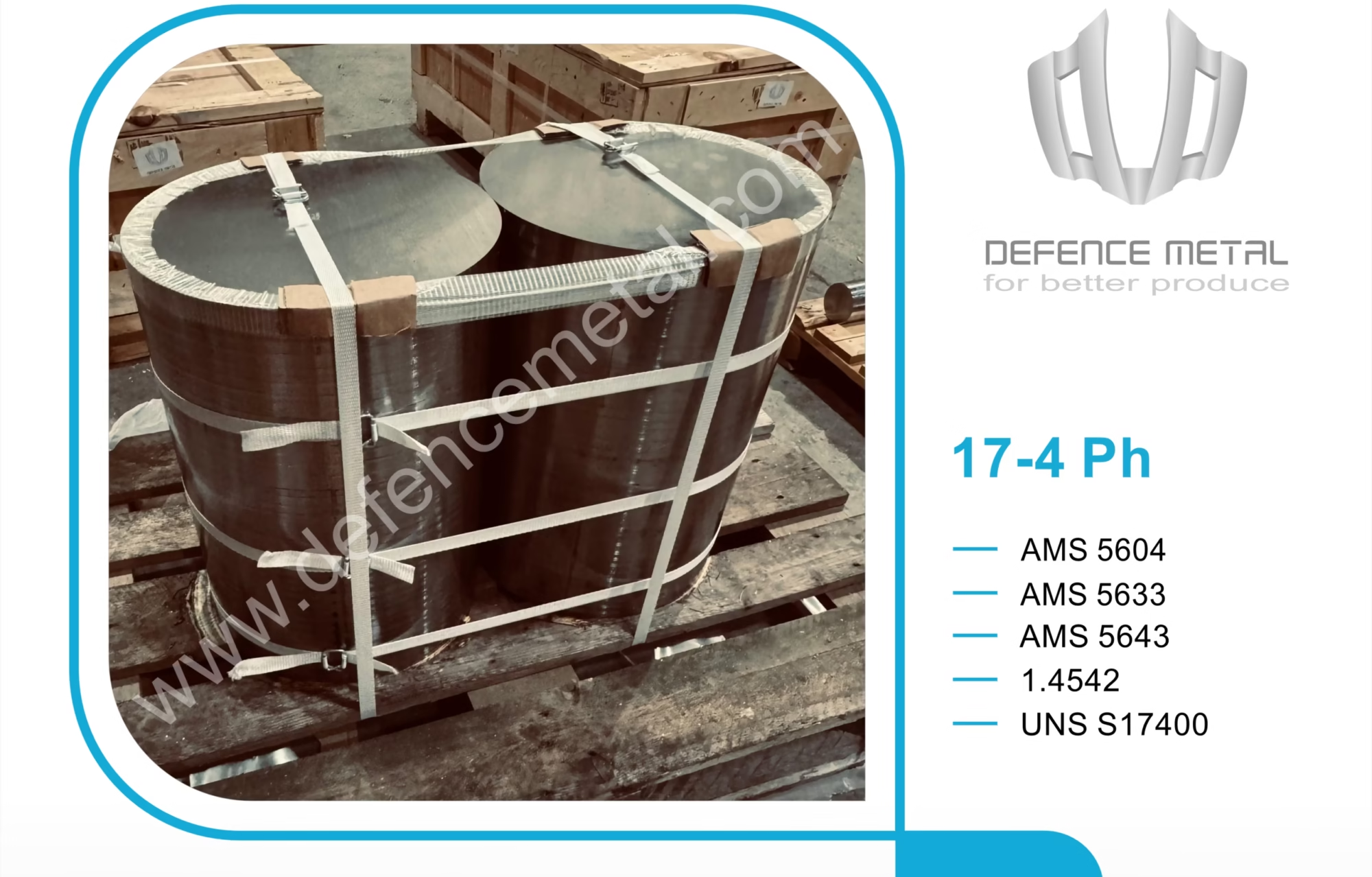
17-4 PH
17-4 PH Stainless Steel: The Optimum Balance of High Mechanical Strength and Corrosion Resistance
17-4 PH stainless steel is a versatile engineering material in the precipitation hardening martensitic stainless steel class, standing out for its high mechanical strength, good toughness and satisfactory corrosion resistance. Regarded as the forerunner of advanced variants such as 15-5 PH and 13-8 Mo, 17-4 PH has been used for some 70 years across a wide industrial field, from aerospace to petrochemicals. Thanks to the copper and niobium it contains, its mechanical properties can be raised by heat treatment. That property makes it one of the most popular choices among the “age-hardening stainless steels”.
17-4 PH Chemical Structure and Microstructural Properties
The name 17-4 PH indicates that the alloy contains roughly 17% chromium and 4% nickel. This basic composition gives the alloy both its stainless character and a structure suitable for precipitation hardening. The alloy typically contains 3–5% copper and between 0.15 and 0.45% niobium. Copper causes intermetallic precipitates to form during the ageing heat treatment, and high hardness values are reached in this way. Niobium, in turn, forms carbides with carbon and provides stability at the grain boundaries.
After solution annealing the alloy has an austenitic structure. Rapid cooling transforms it to a martensitic structure. Ageing treatments are applied at various heat treatment grades such as H900, H1025, H1075, H1100 and H1150. After H900 ageing in particular, a tensile strength of over 1300 MPa and a hardness of roughly 44 HRC can be obtained. This hardening mechanism relies on the spread of copper-rich precipitates in the microstructure.
Standardisation and Quality Control for 17-4 PH
17-4 PH is regulated by various internationally recognised standards. The most important standards are:
- ASTM A564 / A564M: for bar, plate and forged products.
- AMS 5643: for bar and wire products used in aerospace applications.
- AMS 5604: plate and sheet products.
- UNS S17400: the general chemical designation of the alloy.
17-4 PH steels produced under these standards pass through quality control processes such as non-destructive examination, grain size control, tensile testing and microstructure verification after ageing. Special production techniques such as vacuum arc remelting (VAR) or electroslag remelting (ESR) are preferred for applications requiring high purity and inclusion control.
17-4 PH Trade Names and Supply Chain
This alloy appears on the market under a great many trade names: 17-4PH®, UNS S17400, Type 630, Alloy 630, and DIN 1.4542 are the most common. In the European standard its equivalent is designated X5CrNiCuNb16-4. The alloy can be supplied as plate, bar, forging, wire, tube and fasteners.
17-4 PH Applications and Engineering Uses
17-4 PH stainless steel is preferred in environments where corrosion resistance is required alongside mechanical strength. The most important advantage of the alloy is that, despite its hardenable martensitic structure, it is weldable. It therefore finds widespread use in the following sectors:
- Aerospace: aircraft landing gear components, fasteners, engine parts, landing gear pivots.
- Defence: missile guide rails, gun turret connections, tank parts.
- Energy: turbine shafts, pressure valve components, steam line brackets.
- Petrochemicals: pump shafts, valve bodies, flange systems.
- Medical and food: autoclave components, sterilisation system parts.
- Machine tools: die pins, press plates, die components requiring high impact strength.
The common feature of these applications is the need for parts working under high mechanical load in variable environmental conditions. In that sense 17-4 PH offers an optimal solution in terms of both material reliability and machinability.
Machinability and Production Processes
Although this alloy shows higher hardness than the austenitic stainless steels, its machinability after solution annealing is good. Machining operations are generally carried out in the solution annealed condition and the required ageing (H900, H1025 and so on) is then applied. In terms of machining, although 17-4 PH is harder to machine than austenitic 304 or 316, it shows quite favourable cutting behaviour for its martensitic character. As hardness increases after ageing, the difficulty of machining increases as well.
In terms of weldability, the best results are obtained in the solution annealed condition. Strength can be preserved by re-ageing after welding. Microstructural transformations in the weld zone must be monitored carefully, because cracks or hard zones that may form after heat treatment can affect structural strength.
Corrosion Resistance Assessment
Thanks to its 17% chromium content, 17-4 PH stainless steel shows typical stainless behaviour. It gives successful results in industrial damp environments less aggressive than seawater, in mildly acidic solutions and in salt spray tests (ASTM B117). While it provides higher mechanical performance than 304 stainless steel, it is slightly behind the austenitic classes in terms of corrosion resistance. Even so, it is one of the best-performing precipitation hardening steels in the martensitic class.
Ageing treatments carried out after welding can significantly affect corrosion resistance. While corrosion resistance can be improved with high-temperature ageing (such as H1150), low-temperature ageing such as H900, although it increases hardness, can adversely affect passivation behaviour. The service environment and the heat treatment strategy should therefore be assessed together.
Advantages:
- A tensile strength reaching 1300 MPa after ageing.
- Good ductility with elongation in the 10–15% range.
- Good weldability and machinability.
- Dimensional stability after ageing (particularly in the H1025 and H1100 conditions).
- A wide choice of product forms: bar, plate, tube, forged part.
- Suitability for the aerospace and defence sectors thanks to conformity with ASTM and AMS norms.
Disadvantages:
- Lower corrosion resistance than the austenitic stainless steels.
- Machinability decreases after hardening.
- It is magnetic in character; this can be a limitation in some electromechanical applications.
- Its stability in high-temperature applications is limited (it is not suitable for long-term use above roughly 300 °C).
- If ageing is not carried out after welding, the weld zone can become brittle.
Purchasing and Engineering Assessment
In engineering projects where the application is critical, forged parts in particular should preferably conform to AMS 5643 and be produced by the vacuum arc remelting (VAR) procedure. This increases the mechanical reliability of the alloy while also reducing the risk of early fatigue caused by contamination.
17-4 PH is a strategic material both in high-performance prototyping and in series production processes. From the design engineer’s point of view, the ability to tune the mechanical properties to the target through different ageing grades is a great advantage. For production and supply chain managers, the availability of the alloy in a wide variety of forms brings logistical flexibility.
#AISI 630
#17-4Ph
#UNS S17400
#X5CrNiCuNb16-4
#1.4542
#ASTMA484
#ASTMA564
#ASTMA693
#AMS5604
#AMS5622
#AMS5642
#AMS5643
| Chemical Properties | Min. | Max. | Mechanical Properties | Value | |
|---|---|---|---|---|---|
| C | - | 0.070 | Tensile Strength (MPa) | 1070-1270 | |
| Mn | - | 1.00 | Proof Stress (MPa) | 1000 | |
| Si | - | 1.00 | Elongation A50 mm | 10 | |
| P | - | 0.040 | Hardness Brinell | 363 Max HB | |
| S | - | 0.030 | Density | 7.75 g/cm3 | |
| Cr | 15.00 | 17.50 | Melting Point | 1400-1440 °C | |
| Ni | 3.00 | 5.00 | Modulus of Elasticity | 197 GPa | |
| Cu | 3.00 | 5.00 | Electrical Resistivity | 800 nΩ.m | |
| Nb+Ta | 0.15 | 0.45 | Thermal Conductivity | 18.4 W/m-K | |
| | | Thermal Expansion | 10.8 µm/m°C |
We supply this material
We supply 17-4 PH (1.4542) — to AMS 5622 and AMS 5643, in the size and form required. For stock and pricing:
Related products
17-7 PH · Custom 455 · 13-8 PH · 15-5 PH · Precipitation hardening steels →