
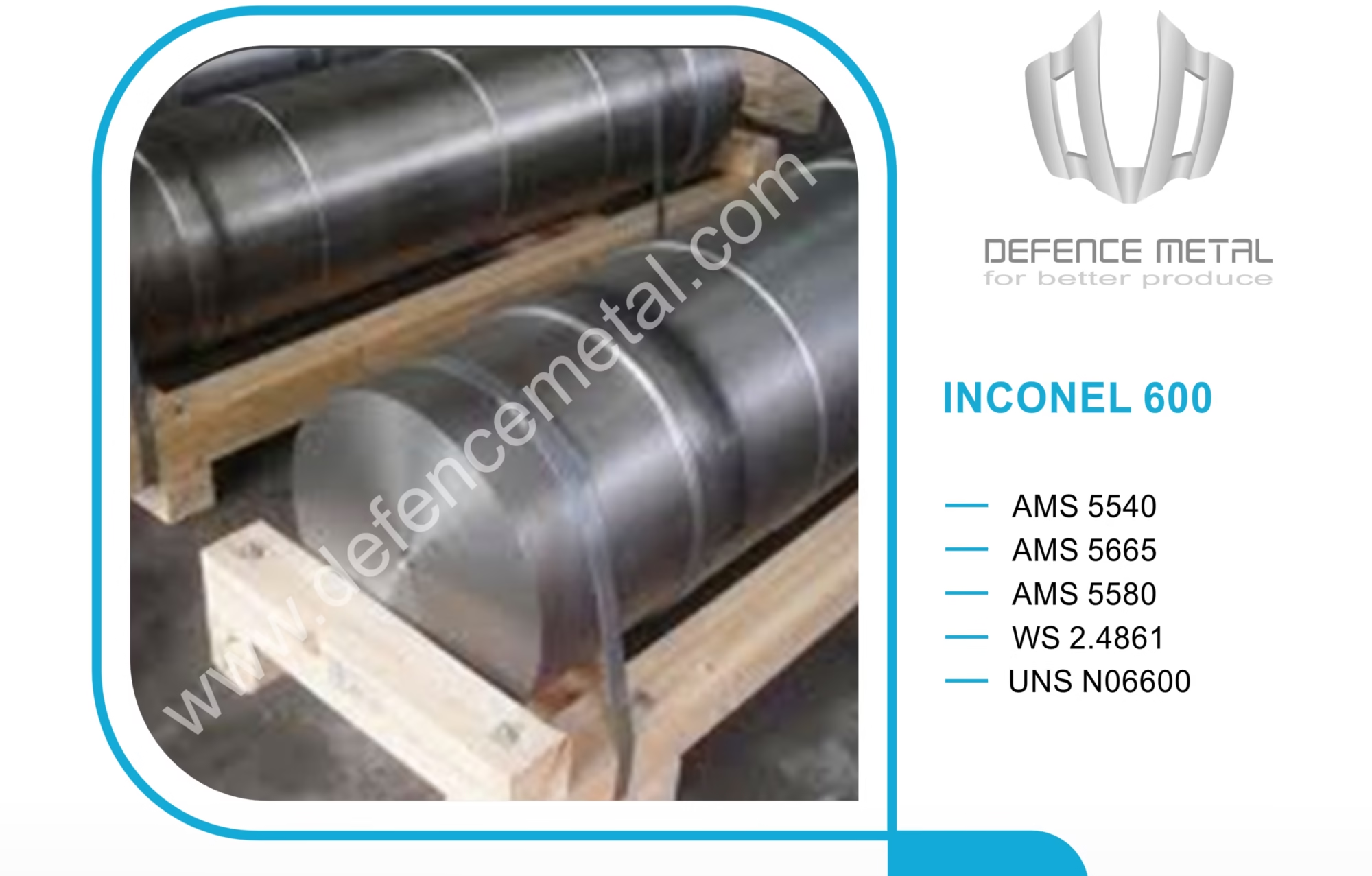
INCONEL 600
INCONEL 600, (UNS N06600): The Industrial Interpretation of High Temperature and Corrosion Resistance
Technical Description
Inconel 600 is a nickel-based super alloy containing essentially 72% nickel, 14-17% chromium and 6-10% iron. This alloy is preferred in critical process equipment because of its structure, which is resistant to oxidation, carburisation and chloride stress corrosion cracking at high temperatures. Bringing together medium grade mechanical strength with superior oxidative resistance properties makes it ideal for both thermally and chemically demanding conditions.
Inconel 600 shows ductility and formability at high temperature thanks to its face centred cubic (FCC) crystal structure. The specific gravity of the material is approximately 8.47 g/cm³, and its melting point is between 1354–1413°C. It largely preserves its strength values even at high temperatures. Its typical mechanical properties at room temperature are defined by approximately 520 MPa tensile strength, 210 MPa yield strength and 45% elongation at break.
The most distinctive property of the alloy is that, under a very wide variety of environments and temperature conditions, it forms a stable passive film layer and thereby prevents corrosive agents from penetrating. This property applies in dry chlorine gas, sulphur compounds and oxidising environments at high temperature as much as in acidic and alkaline solutions.
INCONEL 600 Relevant Standards
Inconel 600 has been defined in detail in international standards, especially for fields such as aerospace, chemicals, energy and the nuclear industry. The principal standards are as follows:
- ASTM B166: Bar, wire and section products
- ASTM B168: Sheet and strip products
- ASTM B167: Seamless pipes
- ASTM B564: Forged flanges, forged parts
- AMS 5540: Sheet, strip and foil products
- AMS 5665: Bar, forging and ring products
- AMS 5580: Tube and pipe products
- ASME SB-168 / SB-167: Versions for pressure vessel applications
- ISO 6208, DIN 17742, Werkstoff Nr. 2.4816: European equivalents
While these standards set out the quality, dimensional tolerance and mechanical testing requirements of Inconel 600, in industrial supply it is designated by the code UNS N06600.
INCONEL 600 Trade Names and Equivalents
- Inconel® 600 – Special Metals Corporation (original producer)
- Nicrofer® 7616 – VDM Metals (Europe)
- Alloy 600 – General industrial use
- NiCr15Fe – EN ISO equivalent
- UNS N06600 / Werkstoff 2.4816 – International material designations
INCONEL 600 Application Areas
Inconel 600 shows superior performance in processes where both oxidising and reducing environments are present together. It is widely preferred especially in systems where the combination of high temperature + corrosion creates a problem:
- Chemical and Petrochemical Industry: It is used in the production of tanks, reactors, piping and heat exchangers in chlorinated solutions, sodium hydroxide, nickel refining processes and organic acid environments.
- Nuclear Power Plants: In nuclear reactors it is preferred in applications requiring high temperature and radiation resistance, such as reactor pressure vessel internal claddings, piping systems and fuel carrying structures.
- Heat Treatment Furnaces and Refractory Systems: Because of its resistance to carburisation and oxidation at high temperature, it frequently appears in heating elements, furnace parts and support frames.
- Aerospace Industry: It is used in places such as jet engine components, exhaust systems, heat exchangers and high temperature valve systems. Thanks to its compliance with the AMS norms it is preferred in safe flight components.
- Food Industry and Pharmaceutical Equipment: Thanks to its chemical stability and inertness it can be used in agitators, cooking and steam lines operating in acidic environments.
- Paper and Pulp Industry: It stands out as an equipment material because of its corrosion resistance in alkaline digestion and in bleaching operations containing chlorine dioxide.
INCONEL 600 Advantages
- Very High Oxidation Resistance :Inconel 600 preserves its structural stability at temperatures up to 1100°C and shows superior resistance to oxidation.
- Resistance to Chloride Environments: The resistance it shows to stress corrosion cracking, especially in environments containing chlorine and chloride ions, makes it valuable for the petrochemical industry.
- Good Weldability: It can be welded without crack formation by methods such as TIG, MIG and resistance welding. It remains stable after heat treatment.
- Thermal Shock Resistance: Since its microstructural stability is preserved against sudden temperature changes, its use in refractory systems is suitable.
- Mechanical Stability: It offers shape stability and fatigue strength in applications requiring medium-high strength.
- Chemical Neutrality: Since it does not react with many acid and alkaline solutions, it does not create contamination with process fluids.
INCONEL 600 Disadvantages
- High Cost: Because of the high nickel content of the alloy, it is significantly more expensive than carbon steel or 304/316 stainless steels.
- Limited Performance with Nitric Acid and Sulphuric Acid:Alternative alloys chosen for this type of environment (for example Hastelloy C-276) may give better results.
- Cold Working Difficulty: Because of the high strength, more force and a special die design may be required during cold forming.
- Not Suitable for Use in Extreme Magnetic Fields :Although its magnetic permeability is low, alternative materials are preferred in some high frequency electronic environments.
Engineering and Purchasing Notes
When purchasing Inconel 600, the product type compliant with the correct norms (bar, sheet, pipe etc.) should be selected taking into account the temperature of the application, the properties of the chemical environment and the mechanical stresses. In welded applications, filler metal of the same grade should be used for a homogeneous joint, and a suitable annealing operation should be recommended after welding.
In critical applications it should always be verified that the products supplied come together with appropriate quality certificates such as AMS 5540 and ASTM B168. In addition, requesting a product certified to EN 10204 3.1 is important for traceability in engineering systems.
Conclusion and Industrial Evaluation
Inconel 600 is one of the leading alloys of its class in applications where thermal and chemical aggressiveness are intertwined. The passivation capacity of nickel and the oxidative durability of chromium come together to give the alloy high temperature resistance, structural stability and chemical neutrality.
The resistance it shows to typical ageing mechanisms such as oxidation and carburisation, especially in systems operating at high temperature, makes it a long-life and safe option. It finds a broad area of use in many sectors, from petrochemical plants to space engineering. However, the engineering selection should be made meticulously, taking into account its high cost and some limited environmental compatibilities.
#Inconel600
#Alloy600
#UNSN06600
#2.4816
#NiCr15Fe
#ASTMB166
#ASTMB167
#ASTMB168
#ASTMB366
#ASTMB564
#AMS5665
#AMS5540
#AMS5580
#Nicrofer®7616
| Chemical Composition (NiCr15Fe) | | Room Temperature Mechanical Properties | |
|---|---|---|---|
| Grade | Inconel 600 (2.4816) | Properties | Values |
| Ni | min 72.0% | Density (Specific Gravity) | 8470 kg/m³ |
| Cr | 14.0-17.0% | Melting Point | 1354–1413°C |
| Fe | 6.00-10.0% | | |
| C | max 0.15% | | |
| Mn | max 1.00% | | |
| Si | max 0.50% | | |
| S | max 0.015% | | |
| Cu | max 0.50% | |
We supply this material
We supply Inconel 600 (2.4816) — to AMS 5665, AMS 5540 standards, in the dimensions and forms required. For stock availability and pricing:
Similar products
Inconel 601 · Inconel 625 · Inconel 718 · Inconel X750 · All nickel alloys →